Automated
Software Cap Labor
What Is Cap Labor (software capitalization) and why does it matter?
Cap Labor, also called software capitalization, changes how your engineering costs show up in your financials. Instead of counting all that spend as a cost this year, the eligible portion gets treated as a long-term investment in something your company built, an asset. That makes your company look more profitable today, typically lifting a key profitability measure called EBITDA by 10 to 20 percent* for software companies, which can directly increase your company's valuation.
*Typical range for software companies; individual results vary based on company-specific factors including engineering headcount, eligible activity mix, and accounting policies
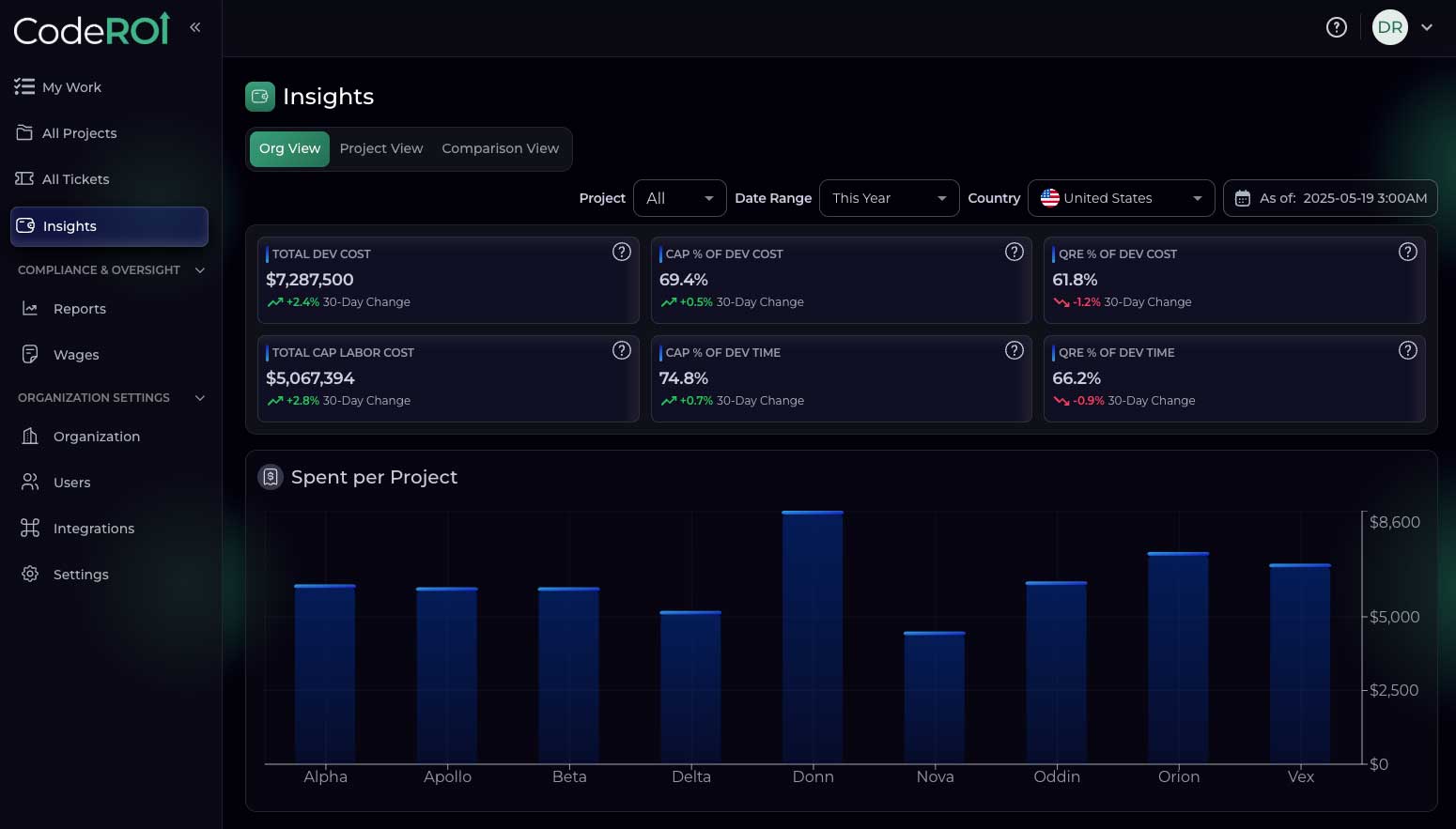
CodeROI automates Cap Labor by capturing real code activity from the systems your engineers already use and generating audit-ready reports with built-in amortization schedules. The output accurately aligns development costs with the revenue they support and is structured to match the format your external auditors expect.
Boost EBITDA and Executive Bonuses
Capitalizing engineering work reclassifies technical payroll from a bottom-line operating expense into a capitalized asset on the balance sheet. The EBITDA improvement is typically 10 to 20 percent for software companies, which makes Cap Labor one of the highest-leverage accounting decisions a CFO can make.
Higher EBITDA directly affects:
-
Company valuation in fundraising and M&A
-
Board reporting and investor materials
-
Executive compensation plans tied to EBITDA targets
Stay Financially Compliant
CodeROI automatically generates GAAP and IFRS-aligned amortization schedules structured for internal review and external audit. The platform supports ASC 350-40 software, ASC 985-20, and IAS 38 reporting requirements out of the box.
Because the underlying data is continuous and defensible, your capitalized assets are export-ready at any point in the year and prepared for audit review with no manual reconciliation. Your auditors see the same evidence your finance team sees, traceable down to the engineering activity that generated it.
Gain Operational Insight
See where your engineering investment is actually going. CodeROI tracks engineering time based on real-time code activity instead of manual estimates or quarterly surveys.
Our engine automatically categorizes engineering effort by project, team, individual, and timeframe, along with dozens of other granular factors, to provide a precise map of how your technical resources are being deployed. The result is a clear answer to a question most CFOs and CTOs can't currently answer with evidence: where is engineering capacity actually going.
Support Strategic Finance
CodeROI scales with your organization and gives finance teams precise control over where capitalization rules apply. Configure controls at the repository, branch, project, or global level, so your capitalization policy reflects how your engineering organization actually works.
This level of granularity means your software capitalization treatment can meet your specific reporting requirements without ever disrupting your existing engineering workflow. Finance gets the controls. Engineering gets left alone.
Most companies only capitalize a fraction of what they're entitled to. CodeROI automates the work and gives you defensible evidence for every dollar capitalized, down to the line of code.
FAQs
How does CodeROI work?
CodeROI connects to the engineering systems your team already uses, including GitHub, and captures real-time evidence of software development activity. That evidence is automatically categorized and turned into audit-ready documentation for software capitalization, R&D tax credits, Section 174 amortization, and SDLC compliance. Engineers do not change how they work. Finance, tax, and compliance teams get defensible data continuously, instead of reconstructing it months after the fact.
Is CodeROI built on AI?
No. CodeROI is built as a deterministic system, not a generative AI engine. Every output the platform produces is traceable down to the specific engineering activity that generated it, with no probabilistic transformation between input and output. AI-generated narratives are not defensible under IRS examination, audit review, or M&A diligence because they cannot be reproduced or explained. CodeROI is built to hold up under the questions that get asked when a credit or a filing is challenged in an audit.
Does CodeROI replace my CPA or tax preparer?
No. CodeROI is built to support your CPA, specialty tax advisor, or filing partner, not replace them. The platform generates the underlying evidence and documentation required to substantiate R&D tax credits, Section 174 amortization, and software capitalization, but the credit itself still has to be claimed, optimized, and defended by qualified tax professionals who understand your broader return. Our model is partnership. We do the heaviest part of the substantiation work so your tax team can focus on judgment, strategy, and filing.
Why should I care if I barely pay any taxes?
Most CodeROI benefits do not depend on owing federal income tax in the current year. For qualified small businesses, R&D tax credits can often be used to offset payroll taxes, giving pre-profit software companies a way to benefit before they have income tax liability. Any unused federal R&D tax credits can also be carried forward for up to 20 years as a tax asset on your books, creating long-term value even if you cannot use the full credit immediately. Software capitalization under ASC 350-40, or Cap Labor, can improve EBITDA by 10 to 20 percent regardless of tax position, directly supporting valuation, board reporting, debt covenants, and executive compensation. SDLC compliance evidence also supports SOC 2, ISO 27001, and M&A diligence. The case for getting this right is about cash flow, trust, traceability, and long-term value, not just current-year income tax savings.
What is the difference between Cap Labor and Section 174?
Cap Labor and Section 174 are different regimes. Cap Labor, formally software capitalization under ASC 350-40 under US GAAP or IAS 38 under IFRS, is a financial accounting treatment that determines how engineering payroll appears on your balance sheet and income statement. Section 174 is a US tax provision for research and software development costs. Under current rules, domestic R&D/software development costs can generally be expensed in year one, while foreign R&D/software development costs must generally be capitalized and amortized over 15 years. Even when domestic costs are immediately deductible, companies still need clear, sustainable evidence separating R&D from non-R&D work. CodeROI helps classify engineering activity so companies know what can be expensed immediately, what must be amortized, and what evidence supports each position.
Can I get these tax savings if I only have contractors and no employees?
Yes, with caveats. Contractor costs can qualify for R&D tax credits, generally at 65 percent in the U.S. and 80 percent in Canada for eligible arm’s-length SR&ED contractors. Contractor work can also support Cap Labor under GAAP or IFRS when tied to capitalizable software development. Separately, contractor software development costs may fall under U.S. Section 174, where domestic costs can generally be expensed immediately and foreign costs must generally be amortized over 15 years. Contractor substantiation is stricter, so tax authorities and auditors need clear evidence of what work was performed, by whom, where, and on which projects. CodeROI captures that evidence directly from the engineering systems your contractors use.
Can I get these tax savings if all the work is performed abroad?
Yes, however, there are limits.
R&D Tax Credits:
You can usually claim credits in the country where the work is performed. For example, in the United States, you cannot claim credits for R&D performed outside the U.S. In Canada, up to 10% of your credits can come from international work performed abroad. Beyond that, CodeROI can also help you secure credits in the country where the development occurs — so if part of your team is in India, we can help you maximize savings through India’s incentives as well.
Tax Amortization:
You can generally receive the full benefit of tax amortization in most countries—though the specific rules differ by jurisdiction.
For example, in the United States, recent tax reform allows immediate expensing of domestic R&D costs incurred after December 31, 2024, under Section 174A. However, R&D performed abroad must still be amortized over 15 years.
Each country sets its own amortization timelines. CodeROI automatically applies the correct treatment for your development location, ensuring compliance and maximizing your tax savings.
Will CodeROI slow down my engineers?
No. CodeROI is designed to reduce developer distraction, not add to it. Engineers do not fill out surveys, submit timesheets, or materially change their workflow. CodeROI captures evidence from the work already happening, so finance, tax, and audit teams can get what they need without pulling developers into time tracking, evidence requests, or audit support. That means less context switching, less admin work, and more time focused on building software.
What documentation does the IRS require for the R&D tax credit?
The IRS expects contemporaneous evidence showing that qualifying research activities occurred, who performed the work, which projects they supported, and what technical uncertainty was being resolved. Many companies rely heavily on tickets, but tickets are ultimately self-reported notes. They can help provide context, but they do not prove the work actually happened. For software development, the strongest source data is the code repository because it shows actual engineering activity, not after-the-fact estimates or claims. CodeROI captures evidence directly from the code repository as work happens, giving tax teams source-system support tied to actuals, not surveys, estimates, or reconstructed narratives.
How long does CodeROI take to implement?
Most CodeROI customers are fully integrated and capturing evidence within a day. Setup involves connecting CodeROI's app to your source control, like any other app, and inviting your team to our platform. After a one time sign in, your team continues working in their existing patterns and the CodeROI platform begins capturing contemporaneous evidence immediately.
Does CodeROI capture historical data from before we installed it?
No. CodeROI works like an electric meter. The day it's installed is the day evidence capture begins, and everything from that point forward is contemporaneously recorded. This is intentional. Contemporaneous evidence is what holds up under IRS examination and external audit, and reconstructed records of activity that happened before the platform was connected do not meet the same evidentiary standard. For prior tax years, your CPA or specialty tax firm can work with whatever historical documentation already exists. Going forward, CodeROI captures everything.