



Skip to content
R&D TAX CREDIT AUTOMATION

Build Software. 
Get Tax Savings. 

CodeROI is software that captures audit-ready engineering data from your code repositories to support federal and state R&D tax credits, Section 174 deductions, and software capitalized labor reporting (ASC 350-40). Filed by your advisor, or by a partner from our network. 

Most companies only claim a fraction of what they’ve earned. CodeROI automates the legwork and gives you defensible evidence, down to the line of code.

One Platform
Four Offerings

Tax Savings

Unlock up to 50%
Four ways to save: federal & state R&D tax credits & Section 174 tax deductions. Plus SR&ED in Canada.

Cap Labor

Boost EBITDA ~15%
Turn software development from an expense into an asset increasing EBITDA and company valuation.

Compliance

Preventative Controls
Ensure code is tested and approved by separate reviewers. Prevent risky code before it ships, not detect it after.

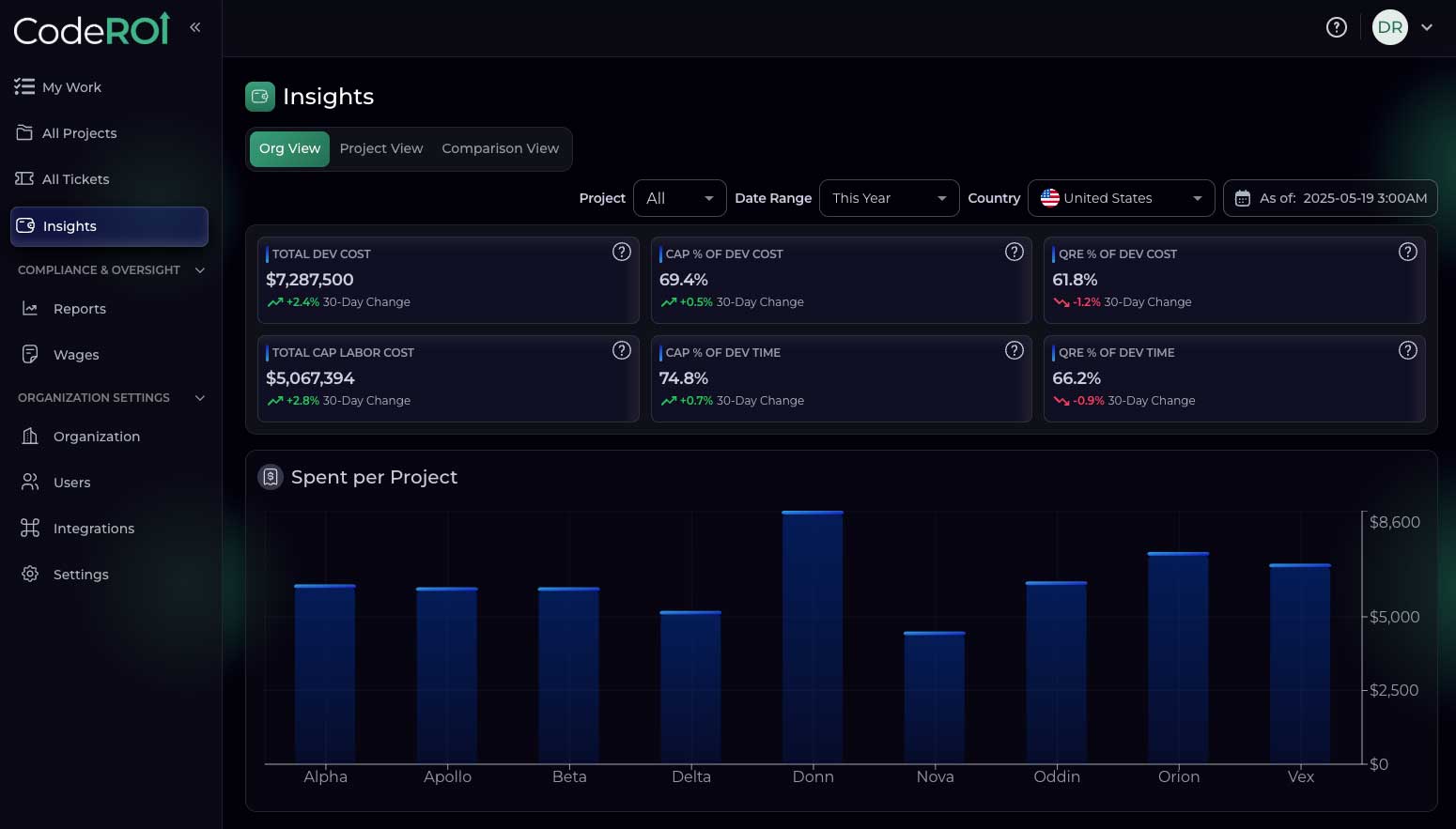
Insights

Engineering Operations
Capitalized labor, cycle time, review lag, and project cost in real time. Finance and engineering in one dashboard.

Savings Calculator

See your potential tax savings in 30 seconds. Estimate R&D credits, Section 174 deductions, and EBITDA lift based on your engineering team.
Team Size
Salary
Time Percentage
Software Dev Spend $10,000,000

$11,684,800

Estimated total value created

Tax
Credits

Federal: $763,000
State: $457,800

Tax Deductions

Federal: $2,289,000
State: $545,000

EBITDA Increase

Value: $7,630,000

💡 CodeROI Cost:

$259,420 → just 2.22% of the $11,684,800 value delivered

That's $45 created for every $1 spent

Unlock 11.6M+ in value with R&D tax credits, Section 174 deductions, and EBITDA lift all while staying compliant.

Estimates provided by this calculator are for informational purposes only and do not constitute financial, tax, or legal advice. The figures shown are illustrative and not a binding quote. Actual R&D credits, Cap Labor amounts, and CodeROI fees depend on your company's specific facts, eligible activities, and applicable tax laws. Estimates assume timely, accurate data and may change without notice. Use of this tool does not create a client relationship. Please consult your CPA or tax advisor before making financial decisions.

Turn Engineering into Tax Savings

CodeROI automatically captures federal R&D tax credits (Form 6765), state R&D credits, Section 174 deductions, and SR&ED for Canadian operations. Sourced from real engineering activity, traced to every line of code, and always audit-ready.

Automated Software Cap Labor

CodeROI captures software capitalized labor (ASC 350-40) automatically from engineering activity in your codebase. Every dollar traced to a line of code, never estimated from timesheets or story points. 

Compliance for the Modern SDLC

Preventative, system-driven IT General Controls (ITGC) for SDLC change management, enforced on every line of code. Test, approve, and segregate duties before code ships. Audit-ready documentation for SOX, SOC 1, SOC 2, and ISO 27001 reviews, traced to source.

Engineering Operations Quantified

CodeROI provides 150+ engineering and finance metrics in one dashboard. Capitalized labor, cycle time, review lag, project cost, and more. Every metric traced to a line of code and based on real code events.

How We're Different

Logo-L3
bo-logo-1
ne-logo-1-1
mainst-logo-1
Tax Credit Support (US & Intl)
R&D + SR&ED (Auto)
R&D + SR&ED (Manual)
R&D (semi-auto)
R&D (manual)
Tax Amortization
State + Federal


Cap Labor Reporting
Real-time, per-engineer


Compliance & SDLC Enforcement
Preventative engineer


Evidence Collection
Preventative Controls, SoD, logs
User Uploads Docs
Manual+ Ticket Estimates
Manual + Ticket Estimates

Audit Readiness
100% coverage, live logs
Manual prep
Estimate logs
Manual prep

Speed & Setup
 < 1 hour
Weeks
Weeks
Weeks

Human Dependency
Fully-auto, CPA-ready
Accountant powered
Semi-auto+ accountants
Accountant powered

Cost
20%of volume
 20-30% of savings + setup fee + platform fee
 20-25% of savings
 20% of savings

FAQs

How does CodeROI work?

CodeROI connects to the engineering systems your team already uses, including GitHub,  and captures real-time evidence of software development activity. That evidence is automatically categorized and turned into audit-ready documentation for software capitalization, R&D tax credits, Section 174 amortization, and SDLC compliance. Engineers do not change how they work. Finance, tax, and compliance teams get defensible data continuously, instead of reconstructing it months after the fact.

Is CodeROI built on AI?

No. CodeROI is built as a deterministic system, not a generative AI engine. Every output the platform produces is traceable down to the specific engineering activity that generated it, with no probabilistic transformation between input and output. AI-generated narratives are not defensible under IRS examination, audit review, or M&A diligence because they cannot be reproduced or explained. CodeROI is built to hold up under the questions that get asked when a credit or a filing is challenged in an audit.

Does CodeROI replace my CPA or tax preparer?

No. CodeROI is built to support your CPA, specialty tax advisor, or filing partner, not replace them. The platform generates the underlying evidence and documentation required to substantiate R&D tax credits, Section 174 amortization, and software capitalization, but the credit itself still has to be claimed, optimized, and defended by qualified tax professionals who understand your broader return. Our model is partnership. We do the heaviest part of the substantiation work so your tax team can focus on judgment, strategy, and filing.

Why should I care if I barely pay any taxes?

Most CodeROI benefits do not depend on owing federal income tax in the current year. For qualified small businesses, R&D tax credits can often be used to offset payroll taxes, giving pre-profit software companies a way to benefit before they have income tax liability. Any unused federal R&D tax credits can also be carried forward for up to 20 years as a tax asset on your books, creating long-term value even if you cannot use the full credit immediately. Software capitalization under ASC 350-40, or Cap Labor, can improve EBITDA by 10 to 20 percent regardless of tax position, directly supporting valuation, board reporting, debt covenants, and executive compensation. SDLC compliance evidence also supports SOC 2, ISO 27001, and M&A diligence. The case for getting this right is about cash flow, trust, traceability, and long-term value, not just current-year income tax savings.

What is the difference between Cap Labor and Section 174?

Cap Labor and Section 174 are different regimes. Cap Labor, formally software capitalization under ASC 350-40 under US GAAP or IAS 38 under IFRS, is a financial accounting treatment that determines how engineering payroll appears on your balance sheet and income statement. Section 174 is a US tax provision for research and software development costs. Under current rules, domestic R&D/software development costs can generally be expensed in year one, while foreign R&D/software development costs must generally be capitalized and amortized over 15 years. Even when domestic costs are immediately deductible, companies still need clear, sustainable evidence separating R&D from non-R&D work. CodeROI helps classify engineering activity so companies know what can be expensed immediately, what must be amortized, and what evidence supports each position.

Can I get these tax savings if I only have contractors and no employees?

Yes, with caveats. Contractor costs can qualify for R&D tax credits, generally at 65 percent in the U.S. and 80 percent in Canada for eligible arm’s-length SR&ED contractors. Contractor work can also support Cap Labor under GAAP or IFRS when tied to capitalizable software development. Separately, contractor software development costs may fall under U.S. Section 174, where domestic costs can generally be expensed immediately and foreign costs must generally be amortized over 15 years. Contractor substantiation is stricter, so tax authorities and auditors need clear evidence of what work was performed, by whom, where, and on which projects. CodeROI captures that evidence directly from the engineering systems your contractors use.

Can I get these tax savings if all the work is performed abroad?

Yes, however, there are limits.

R&D Tax Credits:
You can usually claim credits in the country where the work is performed. For example, in the United States, you cannot claim credits for R&D performed outside the U.S. In Canada, up to 10% of your credits can come from international work performed abroad. Beyond that, CodeROI can also help you secure credits in the country where the development occurs — so if part of your team is in India, we can help you maximize savings through India’s incentives as well.

Tax Amortization:
You can generally receive the full benefit of tax amortization in most countries—though the specific rules differ by jurisdiction.

For example, in the United States, recent tax reform allows immediate expensing of domestic R&D costs incurred after December 31, 2024, under Section 174A. However, R&D performed abroad must still be amortized over 15 years.

Each country sets its own amortization timelines. CodeROI automatically applies the correct treatment for your development location, ensuring compliance and maximizing your tax savings.


Will CodeROI slow down my engineers?

No. CodeROI is designed to reduce developer distraction, not add to it. Engineers do not fill out surveys, submit timesheets, or materially change their workflow. CodeROI captures evidence from the work already happening, so finance, tax, and audit teams can get what they need without pulling developers into time tracking, evidence requests, or audit support. That means less context switching, less admin work, and more time focused on building software.

What documentation does the IRS require for the R&D tax credit?

The IRS expects contemporaneous evidence showing that qualifying research activities occurred, who performed the work, which projects they supported, and what technical uncertainty was being resolved. Many companies rely heavily on tickets, but tickets are ultimately self-reported notes. They can help provide context, but they do not prove the work actually happened. For software development, the strongest source data is the code repository because it shows actual engineering activity, not after-the-fact estimates or claims. CodeROI captures evidence directly from the code repository as work happens, giving tax teams source-system support tied to actuals, not surveys, estimates, or reconstructed narratives.

How long does CodeROI take to implement?

Most CodeROI customers are fully integrated and capturing evidence within a day. Setup involves connecting CodeROI's app to your source control, like any other app, and inviting your team to our platform. After a one time sign in, your team continues working in their existing patterns and the CodeROI platform begins capturing contemporaneous evidence immediately. 

Does CodeROI capture historical data from before we installed it?

No. CodeROI works like an electric meter. The day it's installed is the day evidence capture begins, and everything from that point forward is contemporaneously recorded. This is intentional. Contemporaneous evidence is what holds up under IRS examination and external audit, and reconstructed records of activity that happened before the platform was connected do not meet the same evidentiary standard. For prior tax years, your CPA or specialty tax firm can work with whatever historical documentation already exists. Going forward, CodeROI captures everything.

Automate Your ROI

Your code already builds product. Now let it build margins, too.
app-UI-insights